17 May 2026
Travel Schedules and Their Effects on Accumulator Outcomes in Football and Basketball
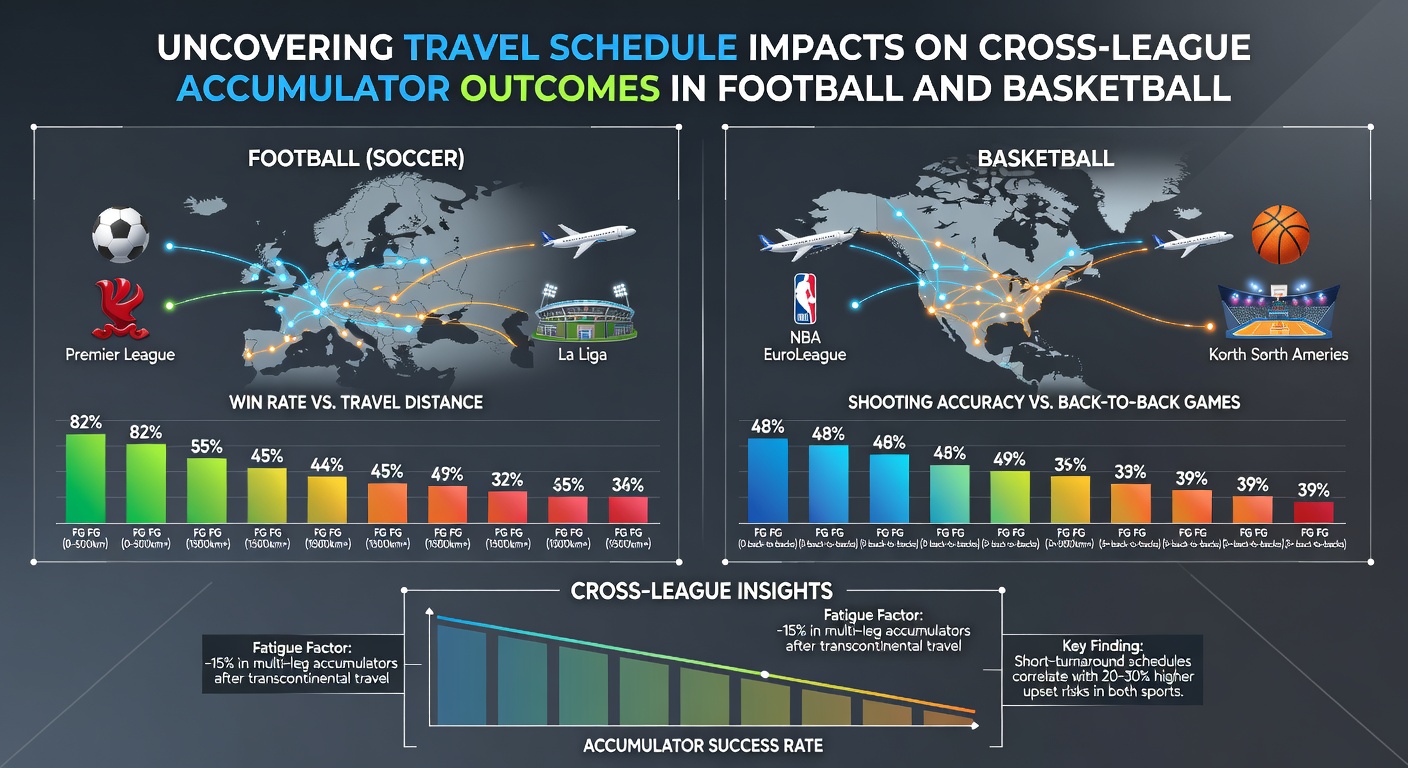
Travel demands shape team performance in measurable ways across football and basketball, and those patterns show up clearly when bettors build cross-league accumulators. Data from league schedules and performance tracking reveal that distance traveled, time zone shifts, and recovery windows alter win probabilities, goal totals, and point margins in consistent directions.
Distance, Recovery Windows, and Football Results
Football clubs that cover more than 1,000 kilometers between domestic or European fixtures record lower expected goal differentials, according to performance databases maintained by Opta and similar analytics providers. Teams returning from continental travel within 72 hours post-match show reduced pressing intensity and fewer high-quality chances created, which directly influences over/under selections in accumulators that pair football matches with basketball totals.
European fixtures in spring often compress recovery time, and those constraints carry forward into domestic rounds. Observers note that away sides in the UEFA Europa League who play midweek and then travel across borders tend to concede more shots in the following weekend fixture, a trend visible in multiple seasons of match data.
Basketball Back-to-Backs and Cross-Country Flights
Basketball schedules present a different but related set of variables. NBA and EuroLeague teams that complete back-to-back games involving flights exceeding four hours post fewer three-pointers and record lower defensive efficiency ratings. League tracking systems document that road teams arriving the morning of a game allow higher opponent points in the paint, particularly when the previous contest occurred in a different time zone.

Those efficiency drops matter when accumulators combine basketball player props or totals with football match results. Bettors who examine flight manifests and arena arrival times can identify games where scoring volume or defensive lapses become more probable, while avoiding selections that rely on rested favorites.
Combining the Two Sports in One Accumulator
Cross-league accumulators gain complexity because football and basketball travel patterns rarely align. A football squad might return from a Thursday night European tie and host a Saturday domestic opponent, while a basketball team in the same city plays three road games in five nights. The overlapping fatigue windows create correlated edges that appear in historical payout records from major sportsbooks.
Studies published in the European Journal of Sport Science examined 12 European football leagues alongside selected basketball competitions and found that teams with the highest cumulative travel loads over a 14-day window underperformed their season averages by statistically significant margins in both points scored and points allowed. Those findings hold after controlling for opponent strength and home advantage.
Schedule Density in May 2026
Fixtures scheduled for May 2026 include compressed playoff and league phases that intensify travel burdens. Football clubs still competing in domestic cups and continental tournaments will face repeated long-haul trips, while basketball postseason series often require rapid coast-to-coast movement. Performance analysts expect these overlapping demands to widen the gap between well-rested squads and those logging extra kilometers.
Public schedule data released by league offices already show clusters of games separated by fewer than 48 hours for several prominent clubs. Bettors reviewing these calendars can isolate selections where travel fatigue is most pronounced rather than relying solely on recent form.
Practical Adjustments for Accumulator Construction
Successful approaches involve layering travel-adjusted metrics onto standard statistical models. Analysts incorporate average distance traveled per game, number of nights away from home base, and time-zone differential as weighting factors when projecting totals or spreads. These adjustments shift implied probabilities enough to change accumulator odds in measurable ways over large sample sizes.
Industry reports from sports data firms indicate that models incorporating travel variables reduce variance in projected outcomes compared with models that ignore logistics. The improvement appears most clearly in midweek-to-weekend transitions and in series that require multiple flights within a short window.
Conclusion
Travel schedules exert a documented influence on football and basketball results that carries through to cross-league accumulator construction. By tracking distance, recovery time, and fixture density, those who study the data identify patterns that alter expected outcomes in both sports. Schedule releases for May 2026 already highlight periods where these factors will be especially pronounced, giving bettors additional context for selections that combine the two leagues.