29 May 2026
Surface Conditions Shaping Betting Markets in Horse Racing and Tennis

Track conditions in horse racing and court surfaces in tennis create measurable shifts in performance metrics that betting operators incorporate when adjusting lines before and during events, and these adjustments reflect documented patterns in speed ratings, player statistics, and historical outcomes across multiple jurisdictions.
Track Variables in Racing Events
Horse racing surfaces respond directly to weather patterns and maintenance practices, with official going reports classifying ground as firm, good, soft, or heavy based on moisture content and penetration resistance, and these classifications correlate with changes in average race times that reach up to several seconds per furlong according to records maintained by the International Federation of Horseracing Authorities. Bettors observe that favorites often shorten in odds on firmer ground where speed-oriented runners hold advantages, while longer-priced stayers gain support when reports indicate softening conditions that increase stamina demands.
Operators monitor real-time data feeds from course officials alongside radar forecasts to move lines, and research compiled by racing analysts shows that heavy ground reduces winning margins for front-runners by an average of 15 percent compared with good-to-firm surfaces. Trainers publish stable plans that reference these variables weeks in advance, allowing markets to price in anticipated adjustments before declarations close.
Court Surface Effects in Tennis
Tennis courts divide into three primary categories—grass, clay, and hard—with each material altering ball bounce height, speed, and spin retention in ways that produce distinct win-rate differentials for players. Grass courts accelerate serves and reward aggressive net approaches, while clay slows trajectories and extends rally lengths, and these differences appear in ATP and WTA databases where surface-specific win percentages deviate by more than 20 points for certain athletes. Hard courts fall between the two extremes yet still vary by manufacturer and court speed rating published by the International Tennis Federation.
Betting lines incorporate these profiles through adjusted totals for games and sets, with over/under markets typically rising on slower surfaces where service breaks occur more frequently. Pre-tournament odds reflect historical head-to-head results filtered by surface, and in-play adjustments accelerate when rallies exceed expected lengths or when players demonstrate unexpected movement efficiency on the day.
Parallel Mechanisms Across Disciplines
Both racing tracks and tennis courts function as dynamic variables that compress or expand performance margins, and operators apply similar statistical models to quantify surface impact on expected outcomes. In racing the official going stick reading provides a numerical input for algorithms, whereas tennis surface pace ratings serve the same purpose, allowing lines to shift in increments that mirror measured changes in event duration and scoring rates. Data collected across European and North American venues indicates that surface-induced variance accounts for a larger portion of result unpredictability than many other factors such as jockey or coaching changes.
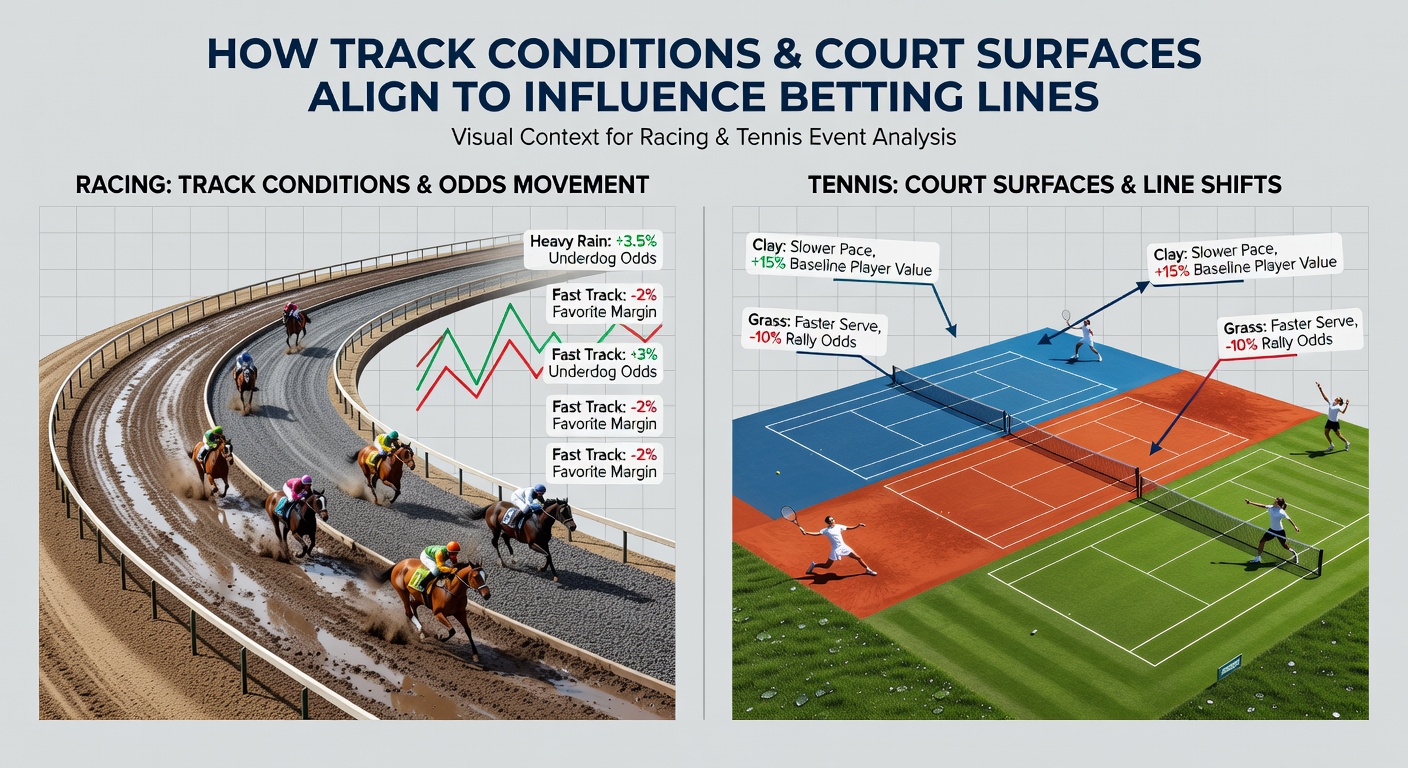
Market makers therefore maintain separate pricing matrices for each surface condition, updating them as environmental reports arrive. When rain arrives mid-meeting or during a tournament week, the resulting line movements follow predictable trajectories documented in industry reports from bodies such as the Arena Racing Company and academic reviews of tennis analytics. These updates occur in real time during May 2026 events, where overlapping schedules of flat racing fixtures and clay-court tournaments create simultaneous demand for surface-aware pricing.
Practical Examples from Recent Seasons
One documented case involved a Royal Ascot meeting where an overnight downpour shifted the ground from good to soft, prompting overnight odds on speed horses to drift while stamina contenders shortened; the final results aligned with pre-race models that had incorporated the revised going. In tennis, players with strong clay records see their implied probabilities rise sharply ahead of Roland Garros, and bookmakers widen or tighten set totals accordingly based on surface-adjusted serve percentages drawn from prior editions of the event.
Observers note that these adjustments remain consistent across jurisdictions because the underlying physics of surface interaction do not change, even as regulatory frameworks differ between the United States, Australia, and European markets. Quantitative studies from university sports science departments confirm that surface friction coefficients directly influence stride length in horses and footwork patterns in tennis players, supplying the empirical foundation for line movements.
Conclusion
Track conditions and court surfaces therefore operate as quantifiable inputs that reshape expected probabilities and drive corresponding revisions to betting lines in both racing and tennis. Operators integrate official reports, statistical databases, and real-time environmental data to maintain market accuracy, and participants who track these variables encounter pricing that reflects documented performance differentials rather than static assumptions. As schedules progress through 2026, continued collection of surface-specific metrics supports ongoing refinement of these models across global betting platforms.